Table of content
Freight forwarding teams can survive a lot of chaos, but unreliable ETA forecasting is where chaos starts sending invoices. When dispatchers do not know whether a shipment will arrive on time, the whole operation shifts into reaction mode. Customer service waits for complaints. Account managers make cautious promises. Dispatchers call carriers again and again. Clients get updates too late, and missed delivery windows turn into penalties. In one of our recent project, we solved a similar data fragmentation challenge by automating document ingestion from emails – but here, the bottleneck was time, not paperwork.
In this case study, we explore how DDI Development implemented a custom AI-powered ETA prediction solution for a freight forwarding company that struggled with inaccurate delivery estimates. The company already had a TMS in place, but its ETA logic was too basic for real-world road freight operations.
Dispatchers relied on experience, spreadsheets, carrier updates, and static route averages. That worked until traffic, weather, warehouse delays, inconsistent carrier data, and tighter client delivery windows made “educated guessing” too expensive.
Why Manual Workflows Are Still Draining Profits from Freight Forwarders
ETA mistakes rarely look dangerous at the start. One truck is “probably on schedule.” One carrier update is “good enough.” One delivery window stays unchanged because nobody has a better number yet.
Then the customer calls first.
That is where manual ETA management becomes expensive. The issue is not only a late truck. The issue is late visibility. By the time the team understands that a shipment will miss its slot, there is often no clean way to fix it.
A similar data problem appeared in customs operations when UPS faced a sharp increase in U.S.-bound shipments that required customs clearance. Some packages were delayed because shipment information was missing or incomplete, and part of the workload needed manual intervention.
For freight forwarders, ETA forecasting breaks in the same quiet way. The system has a planned route, but not enough live context. The dispatcher has experience, but not enough time to check every risk manually. The carrier sends updates, but often too late or too vague. So the company keeps operating with a dangerous gap between what the TMS shows and what is actually happening on the road.
That gap creates the real cost: missed delivery windows, penalty fees, repeated customer calls, rushed replanning, and dispatchers spending their best hours chasing information instead of preventing delays.
Case Study: AI-Powered ETA Prediction from Operational Data into Legacy Freight TMS
A mid-sized freight forwarder operating across Central and Western Europe. The company coordinated road freight through its own dispatch team and a large network of contracted carriers. It did not own every truck it managed. That mattered.
Because the company worked with different carriers, telematics coverage was inconsistent. Some carriers shared location data. Some sent updates manually. Some had portals. Some still behaved as if “in transit” was a complete status update. It was not.
The company had a TMS, but ETA logic was basic. It relied on planned delivery times, route averages, and dispatcher judgment. That worked until clients started demanding tighter delivery windows.
Problem & Pain: Blind ETA, Client Penalties
Client expectations changed faster than the company’s systems. Retail customers wanted delivery windows, not vague delivery days. Manufacturing customers needed better planning because one delayed shipment could stop a line. Account managers wanted proactive updates before the customer complained.
The dispatch team tried to keep up. They checked carrier updates, called drivers, reviewed old shipments, and adjusted ETAs manually. Still, the company’s ETA accuracy was only 56%.
The remaining 44% created a long list of problems:
- Clients complained about “surprise” delays.
- Dispatchers spent more time explaining than planning.
- Penalties increased for missed delivery slots.
- Customer service had to handle repeated “where is my truck?” calls.
- Sales lost trust because operations could not confidently promise delivery times.
- The business had two options.
Buy new GPS hardware and force carrier adoption, which would be slow and politically messy.
Or improve ETA prediction with the data they already had. We chose the second path.
Key Challenges: No Telematics, Historical Data Silos, External Factors Ignored
The project had three major constraints.
1. First, there was no reliable telematics layer across all carriers. We could not assume constant GPS data.
2. Second, historical data was scattered. The TMS had planned and actual delivery times, but some delay reasons lived in emails, notes, spreadsheets, and dispatcher comments.
3. Third, the old ETA logic ignored external conditions. It did not understand weather, traffic, time of day, loading point behavior, destination unloading patterns, carrier reliability, or seasonal lane differences.
That is why the system guessed. It had one average where it needed ten signals.
AI Features Built: Hybrid ML Model: History + Weather + Traffic APIs
We built a hybrid ETA prediction model. It did not depend on a single data source. Instead, it combined internal shipment history with external real-time signals.
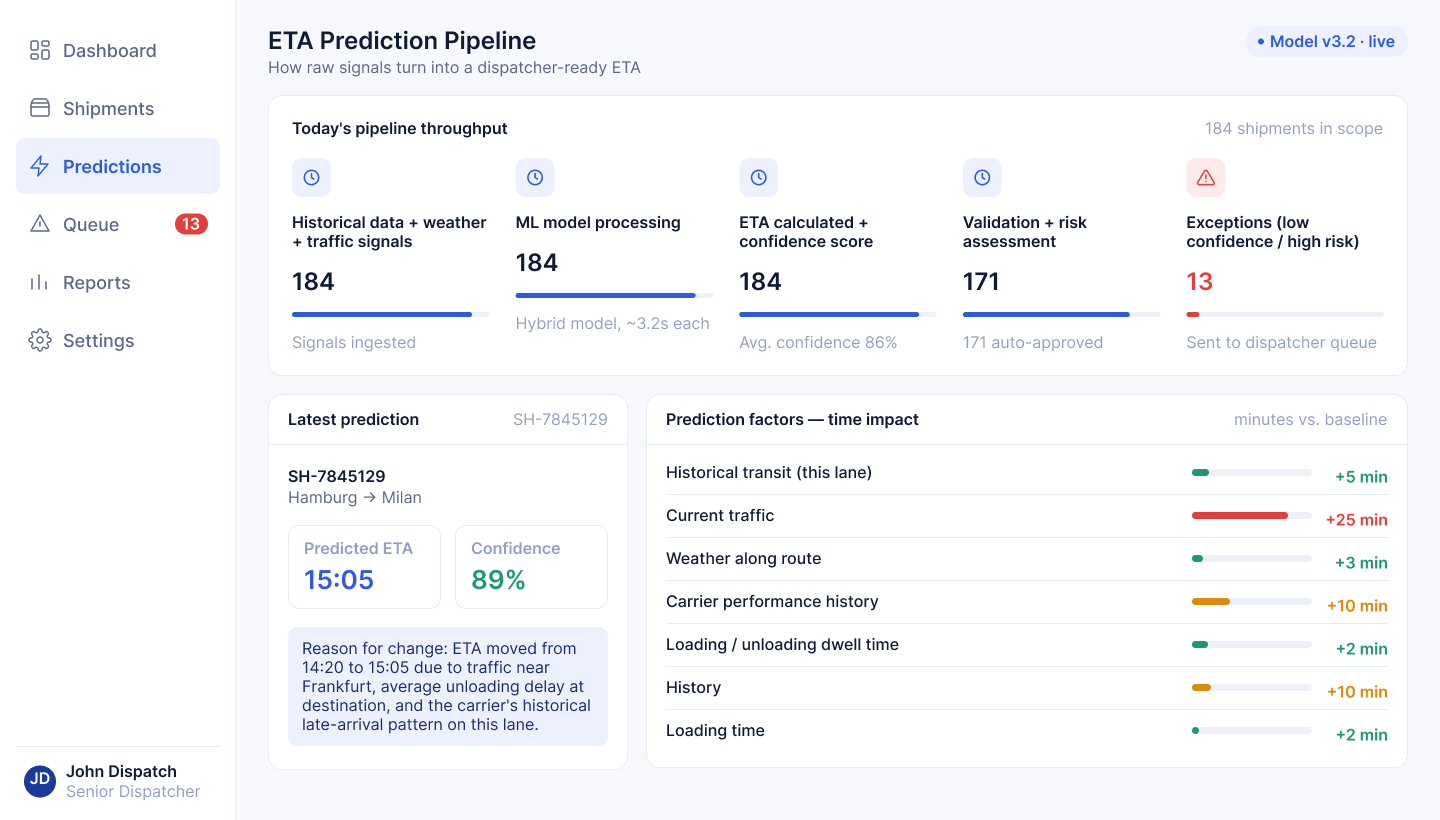
The model used:
- Historical transit times by lane.
- Planned pickup and delivery windows.
- Carrier performance history.
- Driver or subcontractor behavior, where available.
- Loading and unloading dwell time.
- Shipment type and weight class.
- Day of week and time of departure.
- Weather data along the route.
- Traffic-aware route duration.
- Manual milestone updates from dispatchers.
- Delay reason codes from past shipments.
The model produced two outputs: The first was a predicted ETA, the second was a confidence level.
That confidence score mattered. A prediction with 92% confidence should not be treated the same as a prediction with 61% confidence. Dispatchers needed to know when the system was sure and when the shipment required attention.
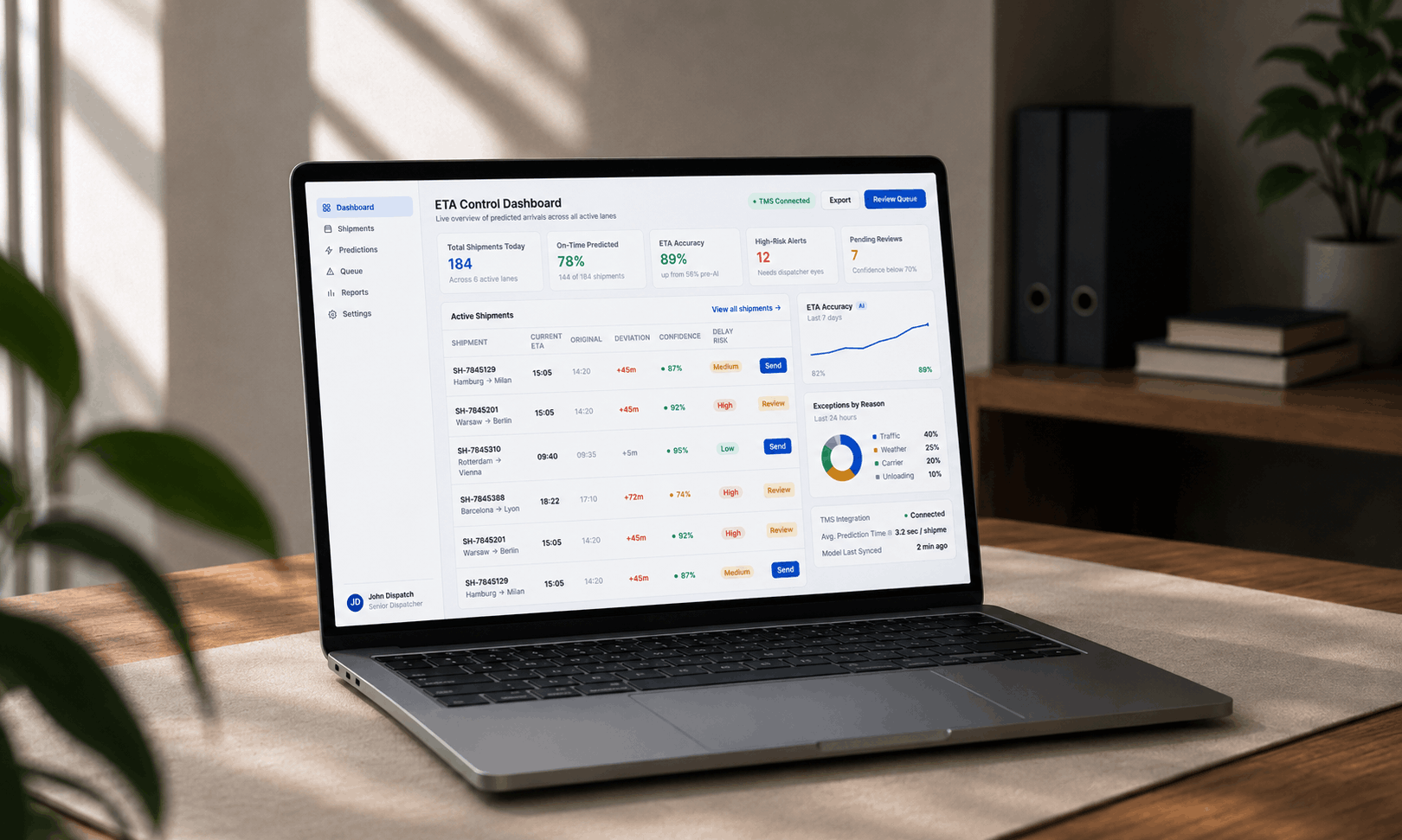
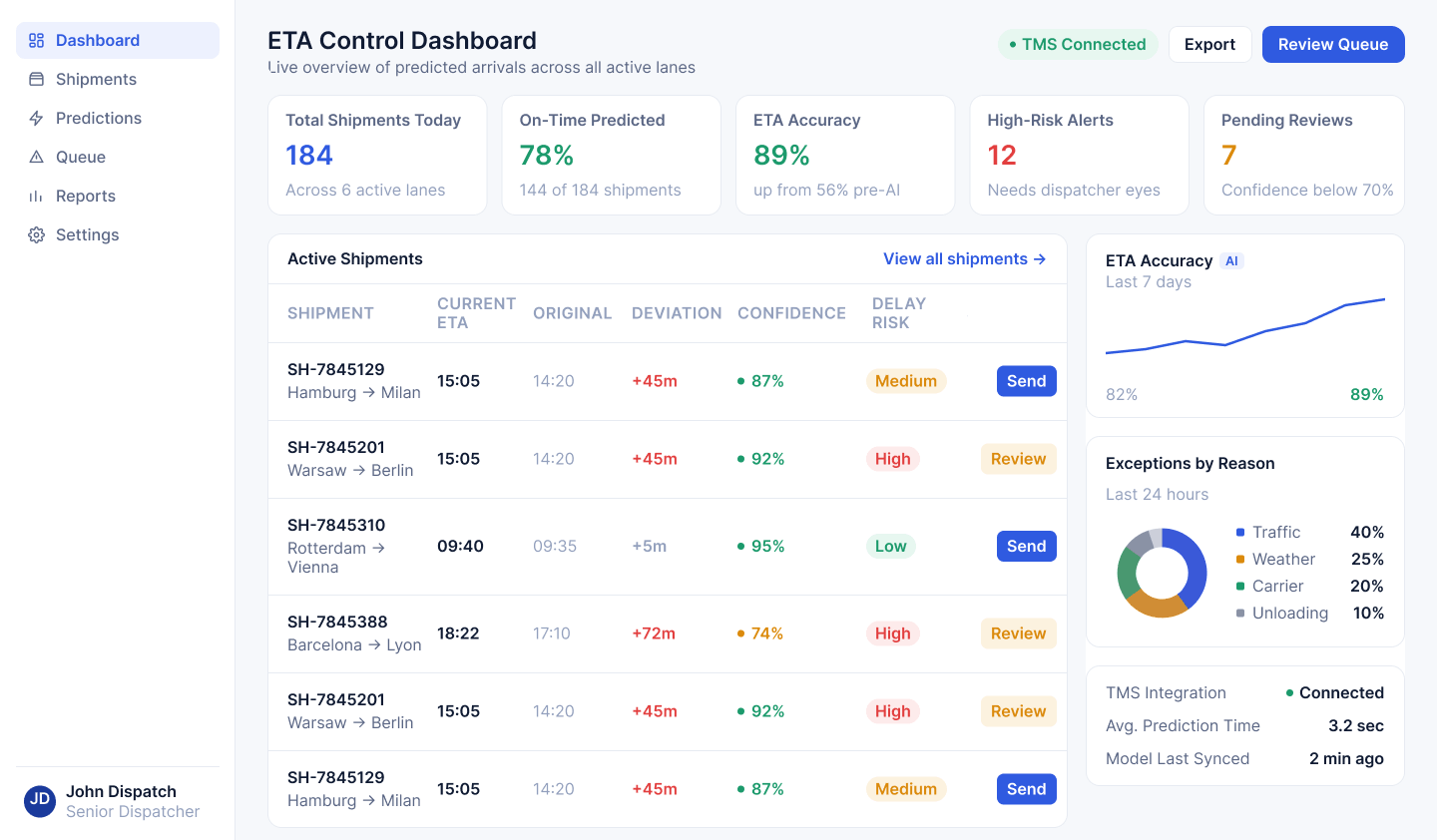
We also built a real-time interface for operations.
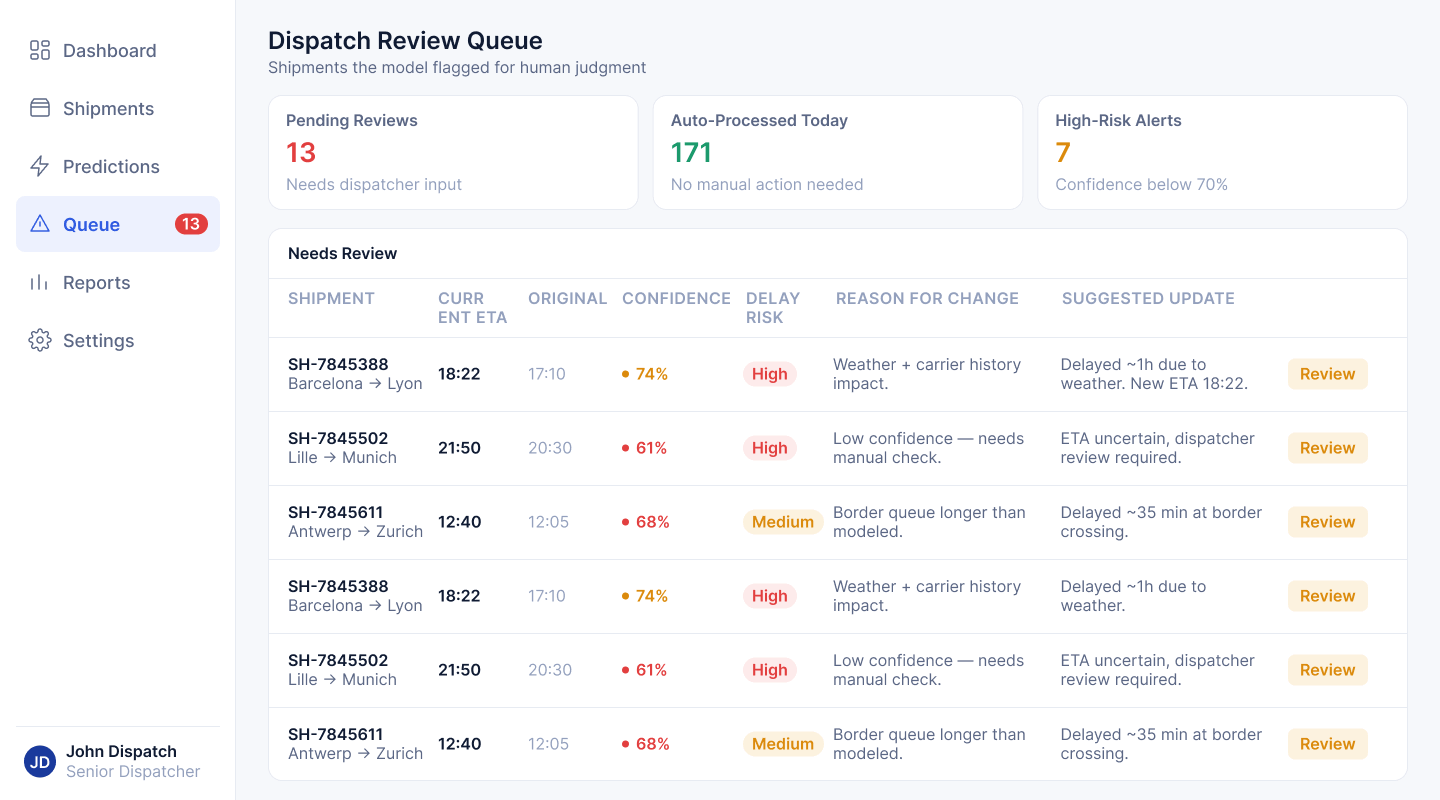
Dispatchers could see:
- Current predicted ETA.
- Original ETA.
- Delay risk.
- Reason for change.
- Confidence score.
- Suggested customer update.
- Exception queue.
- This was not a black box. The system showed why the ETA moved.
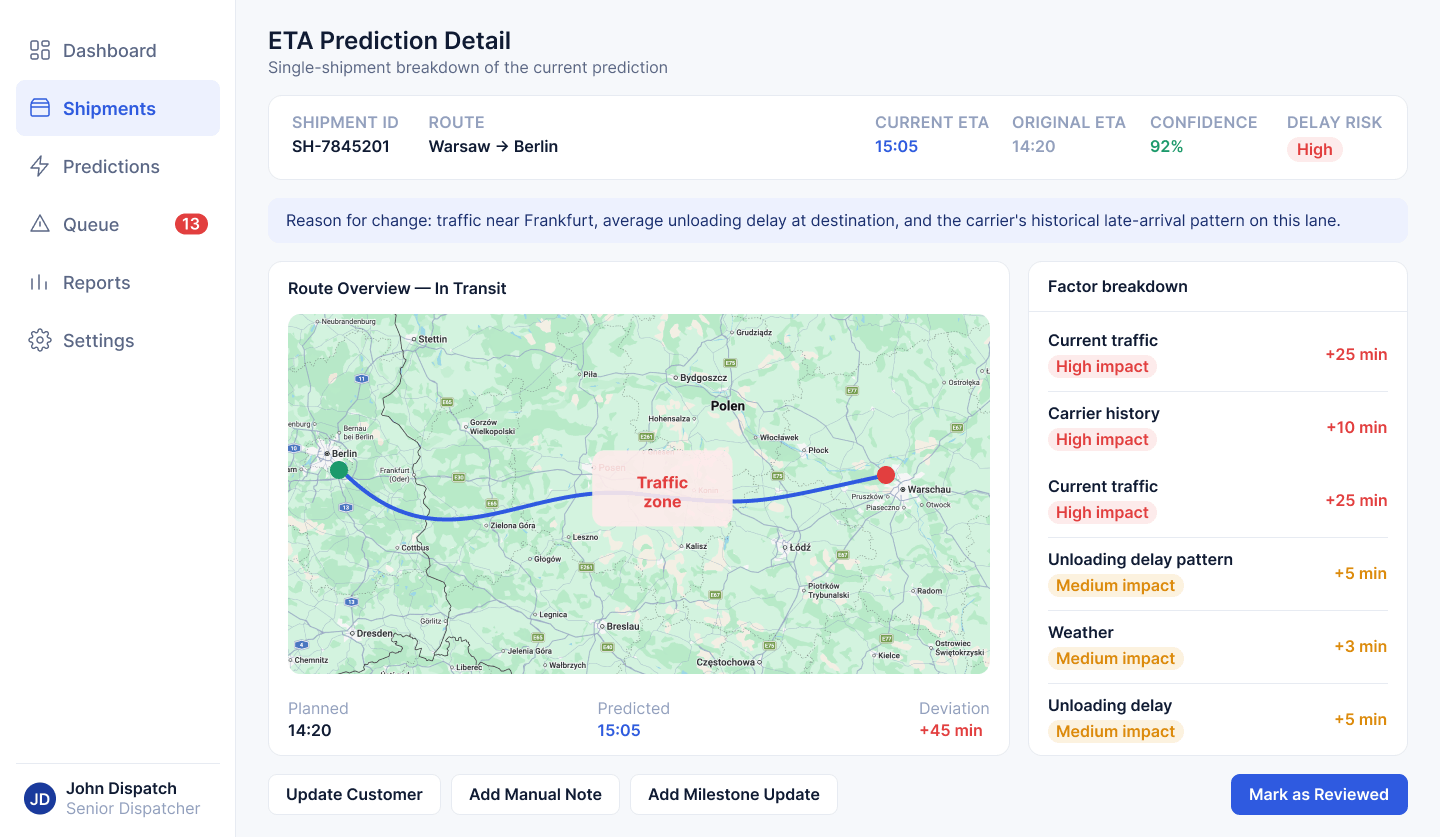
For example:
“ETA moved from 14:20 to 15:05 due to traffic near Frankfurt, average unloading delay at destination, and the carrier’s historical late-arrival pattern on this lane.”
That is a much better conversation than “the system says late.
Results: 89% ETA Accuracy, 40% Lower Penalties, Higher NPS
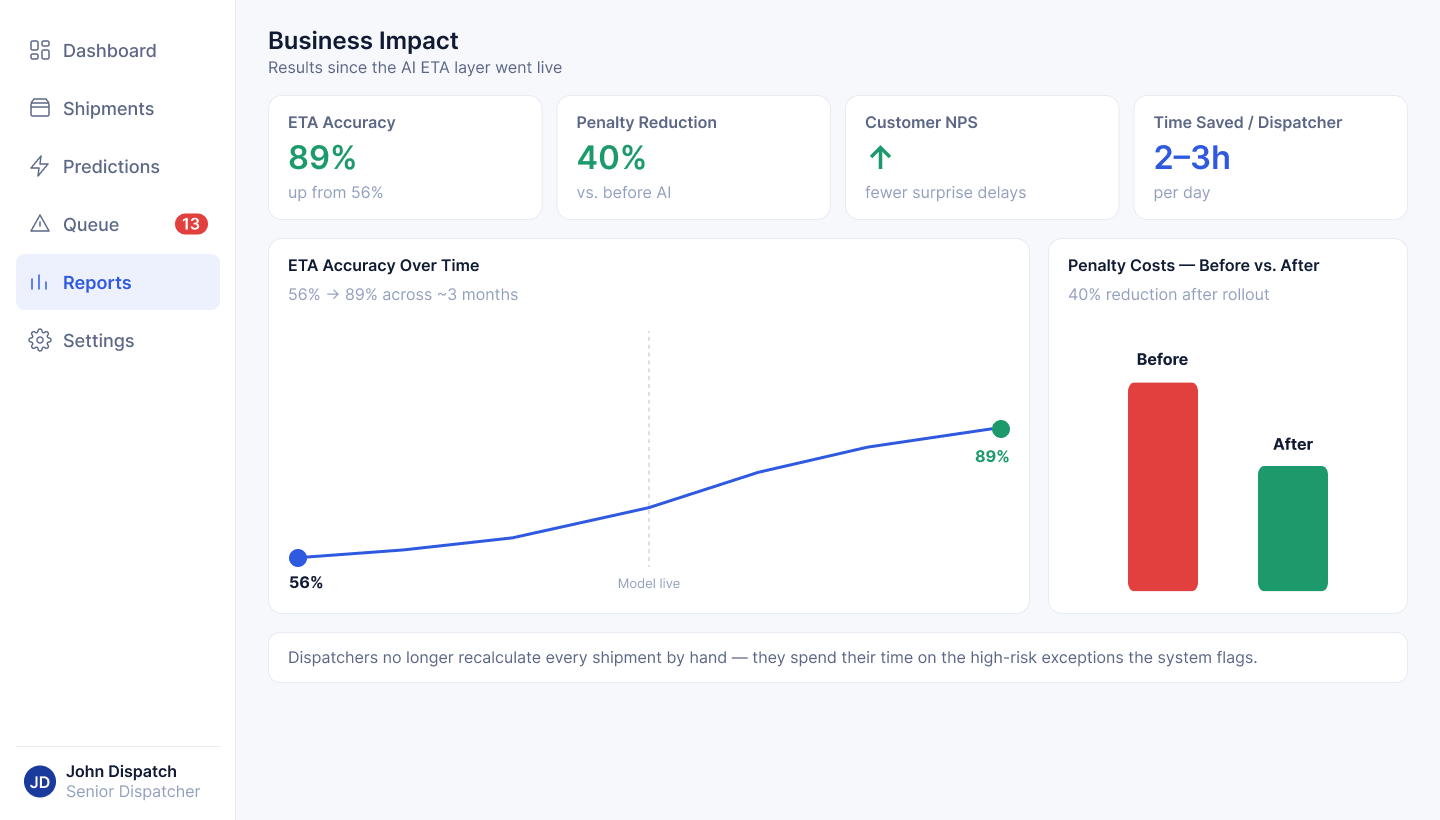
After rollout, ETA accuracy increased from 56% to 89%. That changed how the team worked.
Dispatchers stopped manually recalculating every shipment. They focused on high-risk deliveries and exceptions. Customer service stopped waiting for angry calls because the system could trigger proactive updates when risk increased.
The company also reduced client penalties by 40%. The biggest penalty reduction came from earlier warnings. If a shipment was going to miss a slot, the team could renegotiate, rebook, or notify the customer before the failure became official.
Customer satisfaction improved as well. NPS increased because clients received clearer updates and fewer surprises. The company did not buy new GPS hardware. It made better use of the data it already had.
What This ETA Prediction Case Shows: Better Forecasting Does Not Require Replacing the TMS
This project was not about rebuilding the transport management system. It was about helping dispatchers make better delivery decisions with the data they already had.
The TMS still stored shipments, routes, statuses, customers, and operational records. But the team needed more than stored data. They needed earlier warnings, better ETA accuracy, and a practical way to reduce delay penalties.
So the AI layer became the prediction engine around the existing system.
1. The TMS stayed as the operational source of truth
We did not move dispatchers into a new platform just to improve ETA accuracy.
The TMS continued to store shipment statuses, route details, delivery events, and operational history. The AI layer used that data, combined it with relevant signals, and calculated more reliable ETA predictions and delay risks.
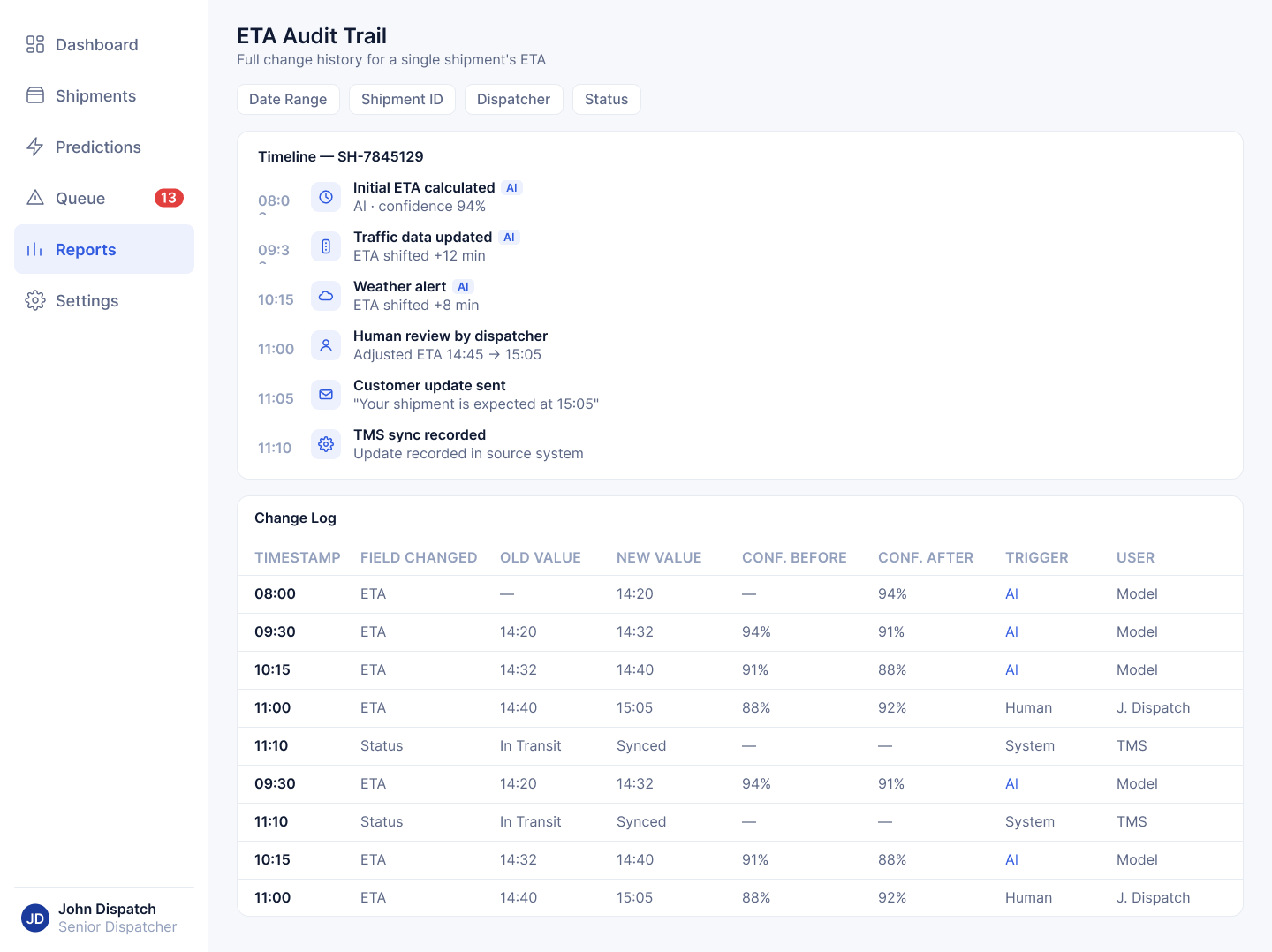
If the client owns the TMS, we can integrate directly into the codebase and add prediction logic, dispatcher alerts, dashboards, and reporting inside the current workflow. If the client uses an external logistics SaaS, we build around it through APIs, exports, webhooks, telematics feeds, scheduled syncs, or custom dashboards.
The system keeps the records. AI improves the decisions.
2. We automated around a measurable business pain
The project did not start because AI sounded impressive. It started because ETA accuracy was hurting operations.
When ETA accuracy sits at 56%, dispatchers spend too much time reacting late. Customers chase updates. Teams miss early warning signs. Delay penalties become easier to trigger and harder to prevent.
The goal was not to replace human dispatchers. The goal was to give them better signals before a shipment became a problem.
3. Humans stayed responsible for judgment calls
ETA prediction is not a magic button. Routes change. Drivers call late. Weather shifts. Border queues grow. A customer may need a different handling rule than the average shipment.
So the system did not blindly decide everything. It calculated delay risk, flagged risky shipments, and surfaced alerts for the dispatch team.
Humans stayed in control of exceptions, customer-sensitive decisions, and operational trade-offs. AI handled the heavy pattern work that people cannot track manually across every lane, shipment, and risk signal.
4. Integration matched the data environment
Some clients have direct access to their transport system. Others rely on SaaS tools where code access is impossible. Both cases can work.
For owned systems, AI can sit inside the TMS workflow. For SaaS platforms, the AI layer can operate as a wrapper, pulling data from available integrations and returning alerts, scores, or dashboards to the team.
That means the company does not need a full telematics rollout or system replacement before proving value. It can start with the decision point that costs money: inaccurate ETAs.
5. Results were tracked through logistics numbers
The success metric was not “we built a model.” The success metric was whether operations became easier to manage.
1. ETA accuracy increased from 56% to 89%.
2. Delay penalties dropped by 40%.
3. Customer satisfaction improved because updates became more reliable.
Dispatchers gained earlier warning signals instead of reacting after the damage was already done. The TMS kept running the operation. The AI layer made the operation smarter.
Why We Kept the TMS Stable: ETA Prediction Needed an AI Layer, Not a Rebuild
Poor ETA accuracy does not always mean the TMS is bad. Often, the TMS stores shipments correctly, but it cannot predict delays well enough because the real signals live outside its core logic.
Traffic changes. Border queues grow. Drivers update late. Weather shifts. A route that looked safe in the morning can become a penalty risk by lunch. Replacing the TMS to solve that problem would be heavy, slow, and expensive.
So we used a cleaner path: keep the system that already runs operations, and add AI where prediction creates business value.
For clients with their own logistics software, we can integrate directly into the existing ERP or TMS codebase. That means adding prediction logic, risk scoring, dispatcher screens, alerts, and reporting inside the tools the team already uses. The core shipment records stay intact, while AI improves the decisions around them.
For clients using an external SaaS TMS, we do not need access to the vendor’s code. Instead, we build an AI layer around the SaaS. It can connect through available APIs, exports, telematics feeds, scheduled syncs, webhooks, or custom dashboards. The SaaS continues to manage shipments, while AI calculates ETA risk, flags delays, and recommends actions before the customer starts chasing updates.
That is the point: the TMS remains the operational source of truth. The AI layer becomes the prediction engine.
If the TMS still stores shipment statuses, do not replace it just to improve ETA accuracy.
If dispatchers already trust the current screens, do not force them into a new system before proving value.
If the business needs fewer penalties, start with the decision point that causes penalties.
The practical roadmap is simple:
1. Find where ETA errors cost money.
2. Pull the data the current system already has.
3. Add external signals where needed.
4. Build the prediction layer.
5. Push alerts back into the team’s workflow.
6. Track accuracy, penalties, and customer satisfaction.
This keeps risk low and speed high. Instead of waiting years for a full platform replacement, the freight forwarder gets better ETA decisions in weeks, with the systems they already know.
Conclusion: How DDI Development Helps Freight Forwarders Improve ETA Accuracy
AI in freight forwarding should solve real operational problems, not add another shiny tool to the stack. For ETA management, that means earlier delay warnings, fewer missed delivery slots, lower penalty risk, and less time wasted on manual recalculation.
We Start with the ETA Gaps That Hurt Most
DDI Development begins with the part of your delivery workflow where inaccurate ETAs already cost money. It may be unreliable carrier updates, penalty-heavy lanes, key customers, or dispatchers spending hours checking routes by hand. We identify where visibility breaks and what data can improve prediction.
We Build Around Your Existing ERP/TMS
You do not need to replace the system your team already uses. We can add an AI layer for ETA prediction, delay risk scoring, carrier reliability analysis, traffic and weather signals, confidence scoring, exception dashboards, customer update suggestions, and ERP/TMS synchronization.
The core platform keeps managing shipments. AI helps your team predict what happens next.
First Pilot, Then Scale
A focused rollout can start with selected routes or customer accounts, covering data review, prototype, integration, testing, dispatcher feedback, and model improvement.
Ready to Stop Guessing ETAs?
Freight forwarding will always have delays. But your team should not discover them too late. DDI Development helps you move from static ETA estimates to predictive delivery control. Let’s Talk.